In the lithium battery R&D stage, electrode coating roughness, SEI film morphology and anode material particle size distribution all depend on AFM measurement. The problem many laboratories face at this step is not "cannot measure accurately", but "there is no need to spend hundreds of thousands on an active isolation table" — the budget needs to go to coin cell testing and electrochemical workstations, yet ordinary rubber pads make roughness data jitter badly. For lithium battery R&D scenarios, LeadTop offers a hollow conical solid isolation solution.
Lithium-battery-related AFM measurements usually fall into two accuracy ranges: electrode coating and calendered surface roughness (Ra 50 nm to several μm), and SEI film and nanoparticle morphology (10–100 nm). The former is relatively tolerant of vibration, while the latter requires stricter low-frequency isolation.
This means the isolation solution does not have to jump straight to active 6-DOF. Choosing a solid isolation table with an appropriate natural frequency strikes a balance between budget and performance.
|
Disturbance source |
Typical frequency band |
Measurement affected |
|
Coating/calendering machines nearby |
20–100 Hz |
Coating surface roughness noise |
|
Fume hood and exhaust |
10–50 Hz |
Periodic scan-line ripple |
|
Glove box operation, personnel movement |
1–20 Hz |
SEI film morphology distortion |
|
Stamping equipment on the floor below |
5–30 Hz |
Long-range scan drift |
The LeadTop POT-G series combines POT-G hollow conical rubber isolators with MOT series optical breadboards. Compared with the conventional POT-P solid rubber isolator (natural frequency of 6.5–12 Hz), the hollow conical structure lowers the natural frequency to 4.0–8.0 Hz, significantly improving isolation in the 5–20 Hz band while retaining the advantages of solid isolation: no air supply required, maintenance-free and a small footprint.
The POT-P solid rubber isolator has a natural frequency of 6.5–12 Hz, which lands right in the dominant disturbance band around fume hoods and coating machines in a lithium battery laboratory, easily producing "the isolation table itself vibrating along with the environment". The POT-G shifts the natural frequency down to 4–8 Hz, avoiding this resonance range and making it more reliable for 10–100 nm-level measurements such as SEI film. The two are close in price, but the POT-G's low-frequency performance is clearly better suited to AFM roughness testing.
|
Parameter |
||
|
Natural frequency |
4.0–8.0 Hz |
6.5–12 Hz |
|
Air supply required |
No |
No |
|
Maintenance cost |
Nearly zero |
Nearly zero |
|
Tabletop flatness |
0.05–0.1 mm/m² |
0.05–0.1 mm/m² |
|
Suitable accuracy |
10 nm to μm level |
Sub-μm to tens of μm |
|
Recommended applications |
SEI film, particle morphology AFM |
Rough measurement, teaching, optical path demonstration |
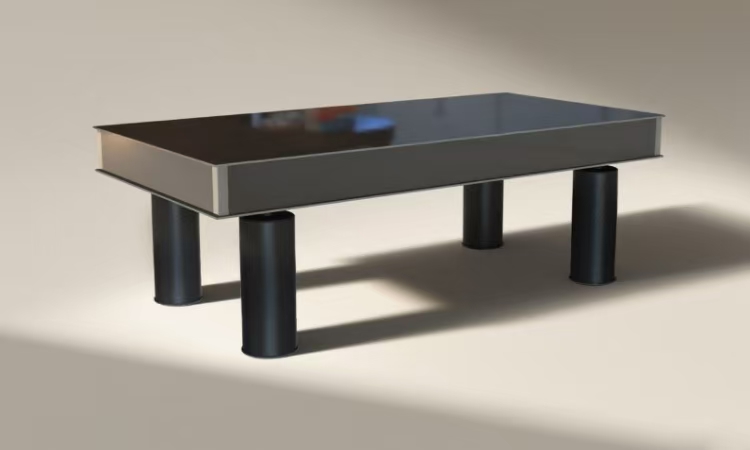

In a lithium battery laboratory, we recommend placing the AFM on a POT-G isolation table at least 3 meters away from the wall where the coating and calendering machines are located; if periodic horizontal stripes appear in SEI film measurements, consider upgrading to a pneumatic solution. LeadTop can match MOT series optical breadboards according to the AFM model and tabletop size, with isolator quantities and mounting holes pre-reserved.


