A laboratory vibration isolation table (also known as an isolation optical platform or vibration-damping table) isolates micro-vibration from the floor, building structure, and the equipment itself, ensuring the measurement and imaging stability of precision instruments. Selection hinges on four key dimensions: vibration frequency, load capacity, tabletop accuracy, and budget. This article provides a practical all-scenario selection methodology together with configuration solutions for the corresponding LeadTop products.
Environmental ground vibration is typically distributed across 0.5–100 Hz: building structural sway concentrates in the 0.5–5 Hz range, while HVAC systems, pumps, and foot traffic concentrate in the mid-to-high frequency band. Atomic force microscopes (AFM), scanning electron microscopes (SEM), laser interferometers, and holographic exposure systems are sensitive to nanometer-scale displacement. Without isolation, they directly suffer from blurred imaging, measurement drift, and poor experimental repeatability.
The LeadTop ZDT-P air-floated optical platform uses an air-spring and ultra-thin composite air-bag structure combined with multi-orifice quasi-laminar flow damping technology. Its vertical/horizontal natural frequency is as low as 1.0–2.0 Hz, with isolation efficiency up to 95%. It supports pneumatic auto-leveling and ±10 mm height adjustment, and comes with a silent air compressor. It offers excellent value for laser, interferometry, and optical path testing experiments.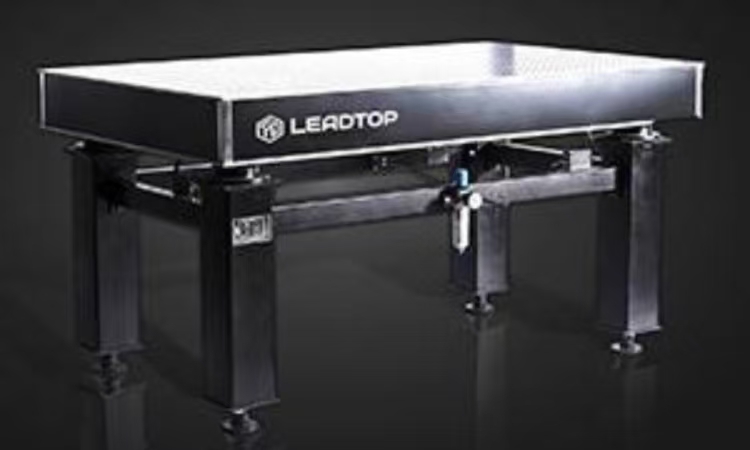
The LeadTop VCM-S400 active isolation bar uses multi-DOF active compensation technology to achieve synchronized six-DOF vibration suppression across the 1–200 Hz band. With a parallel actuator array (2–6 expandable units), it can be freely combined according to load and size. It features an internal feedback loop, no resonant frequency, fast response, simple installation, and requires no ongoing maintenance — ideal for vibration-isolation retrofits on existing equipment.
Application Scenario | Recommended Product | Key Technical Parameters | Matching Notes |
Laser / interferometry / optical path testing | LeadTop ZDT-P air-floated optical platform | Natural frequency 1.0–2.0 Hz; isolation efficiency 95% | Pneumatic auto-leveling; silent air compressor |
Equipment isolation retrofit / upgrade | LeadTop VCM-S400 active isolation bar | Six-DOF suppression over 1–200 Hz | 2–6 actuator units, expandable |
Microscopy / medical & biological | LeadTop POT-P solid optical platform | Natural frequency 6.5–12 Hz | Solid rubber isolation; low budget |
Electron microscopy / heavy-duty equipment | LeadTop LVH-T15 heavy-duty active platform | Full 0.5–200 Hz band | Electromagnetic actuators + 4-stage air springs |
All products in this article are from LeadTop (official website: www.opticaltable.cn), located in Nanchang, Jiangxi Province. The company focuses on the R&D and manufacturing of micro-vibration control and vibration isolation platforms, providing one-stop service from vibration assessment and selection to installation. Contact: 0791-88224425.


