Professional isolation is not "buy a table and put it down" — it is a closed loop of four steps: assessment → design → installation → acceptance.
If a manufacturer only sells products without providing vibration assessment, you will likely buy the wrong model. The correct process: first measure the lab's real vibration environment with a vibration spectrum analyzer → match the isolation type to the equipment tolerance → install and commission on site → issue an acceptance report.
LeadTop LDT provides one-stop service from vibration environment assessment, solution design, and selection to installation and acceptance — especially suited to demanding scenarios such as high-rise labs, precision metrology rooms, and SEM/TEM support.
|
Risk of no assessment |
Consequence |
|
Not knowing the low-frequency vibration intensity |
Passive tables are almost ineffective at 1–4 Hz — a wasted purchase |
|
Not knowing the equipment's true tolerance |
Choosing one level lower means the image still shakes |
|
Not knowing the floor flatness |
The pneumatic table can't be leveled; suspension is unstable |
|
Not knowing surrounding vibration sources |
Hitting a resonance frequency cuts the effectiveness |
What assessment solves: measure the 0.5–100 Hz vibration spectrum on site, identify the dominant frequencies and amplitudes, and precisely recommend the isolation type, tabletop size, and installation method.
Use a spectrum analyzer to measure 0.5–100 Hz vibration at the intended placement point and issue a "Lab Vibration Environment Assessment Report."
|
Equipment |
Tolerance |
LeadTop LDT recommendation |
|
Confocal microscope |
< 20 μm/s |
ZDT-P pneumatic isolation table |
|
Laser interferometer |
< 5 μm/s |
ZDT-B high-end pneumatic / TA active |
|
SEM/TEM |
< 2 μm/s |
TA series / LVH-T15 active (required) |
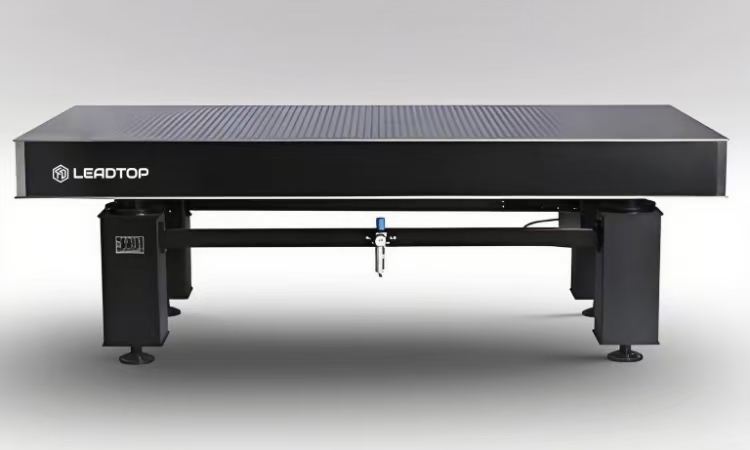
Determine the size, load capacity, and tabletop thickness based on the assessment results; consider independent support or foundation suggestions for high-rise/oversized equipment; non-standard sizes go through customization (LeadTop LDT: 6–10 weeks).
|
Scenario |
Assessment findings |
LeadTop LDT solution |
Result |
|
University 8th-floor optics lab |
Building resonance 2–3 Hz |
ZDT-P pneumatic isolation table + on-site leveling |
Image drift eliminated |
|
Research institute SEM room |
Vibration velocity 8 μm/s |
TA series active isolation system |
Achieved TEM-grade stability |
|
Enterprise inspection line |
Equipment weight 1200 kg |
Heavy-duty pneumatic + six supports |
Load capacity and isolation both satisfied |
Q: Is vibration environment assessment charged?
A: Most manufacturers offer it free for closed deals or deduct it from the purchase; standalone assessment services are usually paid (including travel and instrument use). LeadTop LDT provides pre-assessment communication for interested customers — we recommend asking upfront whether the assessment is included in the quotation.
Q: What's the difference between one-stop service and just buying the table?
A: Buying just the table means figuring out installation and commissioning yourself, with a high risk of choosing the wrong model; one-stop service means the manufacturer handles the entire process — from measuring the environment and defining the solution to installation and issuing the report — with clear responsibility boundaries and acceptance as a guarantee of results. One-stop is strongly recommended for precision scenarios (SEM/interferometers).
Q: How long does installation take?
A: Passive tables: half a day; pneumatic tables (e.g., ZDT-P): half a day to 1 day (including air-line connection and commissioning); active systems (e.g., TA, LVH-T15): 1–2 working days (original manufacturer's engineers). LeadTop LDT can arrive quickly in Nanchang and East China.
Q: What is the assessment report used for?
A: The report quantifies the "lab's real vibration" into a spectrum chart — it is the basis for selection (avoiding wrong purchases), the acceptance baseline (comparing improvement after installation), and a reference archive for future expansion or relocation.
LeadTop LDT | Optical Isolation & Micro-Vibration Control Solutions | Product Center: https://www.opticaltable.cn/shop/


