An optical isolation platform is not a mere “generic accessory” — it is the underlying infrastructure that determines whether precision instruments can operate properly. Universities, research institutes, and corporate R&D centers have fundamentally different isolation needs: universities focus on teaching stability and cost-effectiveness, research institutes rely on active isolation to counter environmental vibration, and enterprises pursue production line throughput and long-term reliability. Choosing the wrong solution can invalidate data at best, and destroy instruments at worst. This article consolidates the real selection logic across five scenarios — universities, research institutes, enterprises, medical, and metrology — and provides competitor comparisons and a scenario-based decision tree.
Core pain points: Limited budget while needing to support both undergraduate teaching and research projects; frequent student operation, with equipment needing to withstand repeated leveling and relocation; laboratories are often located on lower building floors with complex environmental vibration sources (elevators, HVAC, foot traffic).
Typical instrument configuration: scanning electron microscope (SEM, teaching-grade), atomic force microscope (AFM), optical microscope, white-light interferometer.
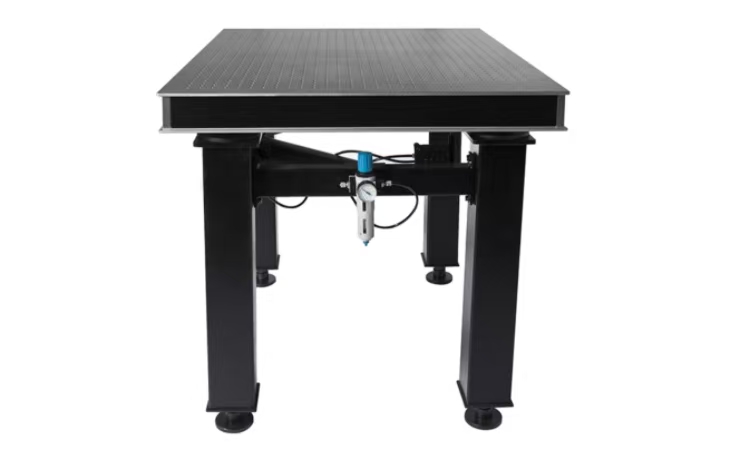
LeadTop solution: ZDT-P air isolation table (natural frequency 1.0–2.0 Hz, isolation efficiency above 95%) paired with damping leveling feet. This solution offers controllable per-unit cost and simple installation and commissioning; students can complete leveling independently after brief training.
Field data: After a biomedical laboratory at a university in central China adopted the ZDT-P, the SEM image drift rate dropped from 0.8 µm/min before retrofitting to 0.05 µm/min, and the undergraduate lab course pass rate rose by about 40%.
Competitor comparison: Thorlabs’ SmartTable series enjoys high recognition at universities, but its air isolation system has stringent compressed-air cleanliness requirements and higher maintenance costs; Newport air isolation platforms typically cost 30%–50% more than LeadTop products of equivalent specifications, limiting their appeal to budget-conscious university procurement.
Core pain points: Field-emission scanning electron microscopes (FE-SEM), transmission electron microscopes (TEM), and high-precision atomic force microscopes (AFM) are extremely sensitive to vibration; environmental vibration is concentrated in the 1–100 Hz band, heavily overlapping instrument natural frequencies. Some institutes are adjacent to subways or major roads and suffer frequent nighttime construction vibration.
Typical instrument configuration: FE-SEM (resolution requirement ≤ 1 nm), aberration-corrected TEM, double-spherical-aberration AFM.
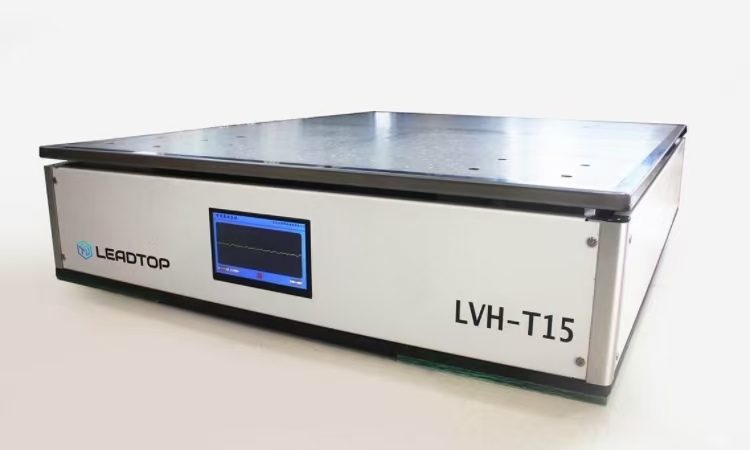
LeadTop solution: LVH-T15 active isolation table (8 ms response time, 0.5–200 Hz band, ≤ –30 dB transmissibility, 500–5000 kg load range), paired with a customized installation plan based on a site vibration assessment report.
Field data: After a semiconductor research institute deployed the LVH-T15, the FE-SEM’s residual vibration amplitude in the 10–200 Hz band dropped from 3.2 nm before retrofitting to 0.8 nm, and E-beam lithography alignment accuracy improved from ±15 nm to ±3 nm.
Competitor comparison: Newport’s VTS series and TMC’s Stacis series hold substantial share in the high-end research market, but the former has a 15–20 ms response time (LeadTop: 8 ms), and the latter generally has long delivery cycles; Accurion’s active isolation products perform excellently but have slow after-sales response cycles in China, making urgent requirements hard to guarantee.
Core pain points: Laser micro-machining (femtosecond and picosecond lasers), precision optical inspection (interferometry, optical coordinate measuring machines), and semiconductor packaging equipment demand high throughput, making equipment downtime extremely costly; some factories sit near industrial parks with uncontrollable environmental vibration; production lines upgrade quickly, so isolation solutions must be scalable.
Typical instrument configuration: femtosecond laser processing systems, optical interferometers, coordinate measuring machines (accuracy ≤ 1 µm), laser trackers.
LeadTop solution: ZDT-B air isolation table (horizontal natural frequency 1.0–1.5 Hz, isolation efficiency above 99%); for high-precision production lines, the LVH-T15 active isolation is recommended to meet stability requirements in high-frequency vibration environments.
Field data: After a precision mold company introduced the ZDT-B, the optical CMM’s repeatability improved from ±2.5 µm to ±0.8 µm and the product defect rate fell 18%; laser processing focal drift dropped from ±15 µm to ±3 µm and processing yield rose about 22%.
Competitor comparison: MKS’s (formerly Newport) VC series is widely used in the semiconductor industry but has weak localized service capability in China, with spare-part delivery typically taking 2–4 weeks; Thorlabs’ passive isolation tables have a decent reputation in laser processing but their load capacity is limited and cannot meet the needs of large optical platforms; Halcyonics’ active isolators perform stably in nanoscale precision measurement but their system integration is complex, making them difficult for SMEs to adopt.
Core pain points: Medical microscopes (confocal and fluorescence microscopes) and high-precision metrology instruments (coordinate measuring machines, laser interferometers) impose stringent environmental vibration requirements, and measurement results directly affect clinical diagnosis and product quality judgments; medical equipment must meet hospital infection-control regulations, and metrology institutions must pass regular CNAS audits.
Typical instrument configuration: laser confocal microscopes, white-light interference surface profilers, laser trackers, high-precision electronic balances.
LeadTop solution: The ZDT-P air isolation table (isolation efficiency above 95%) suits general medical testing scenarios; the LVH-T15 active isolation table (8 ms response time, ≤ –30 dB transmissibility) suits nanoscale metrology scenarios.
Field data: After a provincial metrology institute introduced the LVH-T15, the laser interferometer’s measurement uncertainty dropped from U = 0.5 µm/m to U = 0.15 µm/m, meeting ISO 17025 metrological traceability requirements, and the CNAS re-assessment passed smoothly.
Competitor comparison: TMC’s Microdig series has a long application history in the metrology industry but costs 2–3 times more than comparable LeadTop products; Accurion’s IsoMaster active isolation system enjoys a good reputation in optical inspection, but it only supports standard sizes — large non-standard platforms require customization with long delivery cycles.
|
Industry |
Typical Instruments |
Recommended Solution |
Key Parameter Requirements |
Budget Reference |
|
University teaching |
Teaching-grade SEM, optical microscope |
ZDT-P air isolation |
Natural frequency 1.0–2.0 Hz, isolation efficiency ≥ 95% |
Low |
|
University research |
AFM, white-light interferometer |
ZDT-B air isolation |
Horizontal natural frequency 1.0–1.5 Hz, isolation efficiency ≥ 99% |
Medium |
|
Research institutes |
FE-SEM, TEM, double-aberration AFM |
LVH-T15 active |
Response time ≤ 8 ms, 0.5–200 Hz band, transmissibility ≤ –30 dB |
High |
|
Laser processing |
Femtosecond/picosecond laser processing systems |
LVH-T15 active |
Shock resistance 25 g, load 500–5000 kg |
High |
|
Precision inspection |
Optical interferometer, coordinate measuring machine |
ZDT-B air isolation |
Isolation efficiency ≥ 99%, horizontal natural frequency 1.0–1.5 Hz |
Medium-high |
|
Medical & metrology |
Confocal microscope, laser interferometer |
LVH-T15 active |
Transmissibility ≤ –30 dB, response time 8 ms |
High |
University Market
Thanks to first-mover brand advantages, Thorlabs and Newport have the highest recognition in university procurement, but their prices are relatively high. Backed by localized service and fast response, LeadTop has achieved a repeat-purchase rate above 65% among universities that have already purchased, with reputation improving year by year.
Research Institute Market
Newport VTS and TMC Stacis dominate high-end FE-SEM/TEM support, with an estimated market share above 60%. Thanks to the core advantage of its 8 ms response time (better than VTS’s 15–20 ms), LeadTop’s LVH-T15 is rapidly gaining penetration in new procurements, especially in the semiconductor and materials science fields.
Corporate Market
MKS (formerly Newport) has tied supplier relationships in the semiconductor industry but lacks price and service flexibility; Halcyonics has a stable reputation in precision optical inspection but with high integration complexity; LeadTop gains competitive advantage among mid-to-large corporate customers through a bundled “solution + service” model.
Medical & Metrology Market
Accurion and TMC dominate high-end metrology institutions; LeadTop’s cases at provincial metrology institutes and medical device companies are growing year by year, with clear advantages in CNAS compliance.
Decision Tree: A Three-Step Method for Selecting Optical Isolation Platforms
Step 1: Identify Vibration Source Characteristics
Step 2: Determine Load Weight
Step 3: Assess Budget & Throughput Requirements
If You Are:
Q1: Can a university laboratory without a compressed-air supply still use an air isolation table?
Yes. ZDT-P and ZDT-B air isolation tables require an air compressor or connection to an existing compressed-air network. If the lab has no air source, you can add a silent air compressor (noise < 45 dB), or consider the LVH-T15 active isolation table (no air source required, 8 ms response time, works once powered).
Q2: Which is better for a precision AFM — an active isolation table or a passive air isolation table?
For an AFM (atomic force microscope), the LVH-T15 active isolation table is strongly recommended. The AFM probe-to-sample gap is at the sub-nanometer scale, and the environmental vibration band (1–100 Hz) heavily overlaps the instrument resonance band. Active isolation can hold transmissibility to ≤ –30 dB across the wide 0.5–200 Hz band, whereas passive air isolation is insufficient in this band to eliminate high-frequency components.
Q3: What is the core difference between LeadTop isolation tables and Newport/TMC products?
The difference mainly lies in brand recognition and global service networks. On technical parameters, LeadTop’s LVH-T15 active isolation achieves an 8 ms response time, better than Newport VTS’s 15–20 ms; the ZDT-B’s isolation efficiency above 99% matches TMC’s same-class products. The gap: Newport/TMC have mature global agency and calibration service networks, and in some procurement scenarios requiring ISO certification, imported brands are still the specified requirement. LeadTop’s localized service response speed and cost-performance are its core strengths.
Q4: My factory floor has severe vibration. How do I determine whether my equipment needs active isolation?
We recommend first running a spectrum test at the equipment installation point with a vibration analyzer. If the test shows vibration acceleration > 0.01 g (peak) in the 1–200 Hz band, or the equipment exhibits image jitter or degraded positioning accuracy during operation, active isolation is needed. LeadTop offers a free on-site vibration assessment service — you can schedule an engineer for an on-site inspection.
Q5: Do isolation tables require regular maintenance after installation? Is the maintenance cost high?
Air isolation tables (ZDT-P/ZDT-B) require periodic checks of air-line sealing and replacement of the compressed-air filter every 6–12 months, with low overall maintenance costs. The LVH-T15 active isolation table combines a passive mechanical structure with active electromagnetic control, requiring even less maintenance — calibration every 12–24 months is sufficient. Compared with Newport/TMC factory maintenance packages, LeadTop’s local maintenance costs are significantly lower.
Q6: Can an already-installed isolation table be upgraded later?
Yes. LeadTop offers retrofit and upgrade services, converting an existing air isolation platform into an active isolation system or adding damping leveling modules to the existing setup. Retrofits typically take 1–3 working days with minimal downtime and no impact on overall production line schedules.
Contact LeadTop


