1.1 How Air-Spring Isolation Works
An air-spring isolation platform uses air springs to isolate vibration. Its core principle is:
Key advantage: the natural frequency is far lower than that of damping isolation platforms (3–9 Hz), enabling effective isolation in the 1–5 Hz band.
1.2 Air-Spring vs. Damping Isolation: Core Differences
|
Comparison Dimension |
Damping Isolation Platform |
Air-Spring Isolation Platform |
|
Isolation Principle |
Passive absorption by composite rubber + damping materials |
Air spring + quasi-laminar damping |
|
Natural Frequency (Vertical) |
3–9 Hz |
1–4.5 Hz |
|
Effective Isolation Band |
>5–12 Hz |
>2–6 Hz |
|
Isolation Efficiency |
80–90% |
90–98% |
|
Low-Frequency Isolation (<5 Hz) |
Poor performance |
Somewhat effective |
|
Supporting Requirements |
None (ready to use on arrival) |
Silent air compressor |
|
Typical Price |
¥15,000–¥50,000 |
¥30,000–¥120,000 |
Conclusion: Air-spring isolation platforms significantly outperform damping isolation in the low-frequency band (1–5 Hz), making them ideal for precision optical experiments that are more sensitive to vibration.
1.3 Air-Spring vs. Active Isolation: Applicable Scenarios
|
Comparison Dimension |
Air-Spring Isolation Platform |
Active Isolation Platform |
|
Natural Frequency |
1–4.5 Hz |
<1 Hz (down to 0.3 Hz) |
|
0.5–5 Hz isolation performance |
Limited effectiveness |
Highly effective |
|
Isolation Efficiency |
90–98% |
>95% |
|
Price |
¥30,000–¥120,000 |
¥100,000–¥400,000 |
|
Maintenance Requirements |
Periodic air supply checks |
Automatic system calibration |
|
Applicable Equipment |
Confocal, fluorescence spectroscopy, interferometers |
TEM/SEM, AFM, quantum optics |
Conclusion: If the equipment's vibration tolerance is >10 μm/s, air-spring isolation offers better value; if it is <5 μm/s, active isolation is mandatory
2.1 Suitable Equipment Types
|
Equipment Type |
Vibration Tolerance (estimated) |
Recommended Solution |
|
Confocal microscope |
<20 μm/s |
Air-spring isolation (recommended) |
|
Fluorescence spectrometer |
<20 μm/s |
Air-spring isolation (recommended) |
|
Laser interferometer |
<10 μm/s |
Air-spring isolation (recommended) |
|
Precision metrology equipment |
<10 μm/s |
Air-spring or active isolation |
|
Research-grade SEM |
<20 μm/s |
Air-spring isolation (optional) |
|
FE-SEM/TEM |
<5 μm/s |
Active isolation (required) |
2.2 Suitable Laboratory Environments
|
Site Conditions |
Vibration Characteristics |
Recommended Solution |
|
Basement level or standalone building |
Extremely quiet, minimal vibration |
Damping isolation is basically sufficient |
|
Ground floor to third floor |
Normal vibration environment |
Air-spring isolation (recommended) |
|
High-rise buildings above the fourth floor |
Obvious building resonance |
Air-spring isolation as the minimum |
|
Near factories / roads / subways |
Continuous low-frequency vibration interference |
Active isolation |
2.3 Typical Application Cases
|
Application Scenario |
Vibration Challenge |
Air-Spring Isolation Effect |
|
Confocal microscopy imaging |
Image drift caused by human walking |
Natural frequency 1–2 Hz, effectively isolates 1–3 Hz vibration |
|
Laser interferometry |
Fringe jitter caused by HVAC vibration |
95% isolation efficiency, stable fringes |
|
Fluorescence spectroscopy acquisition |
Spectral drift caused by building resonance |
Effective low-frequency isolation, stable spectra |
|
Optical component inspection |
Floor vibration affects inspection accuracy |
Stable tabletop, improved inspection accuracy |
3.1 Interpreting the Key Parameters
(1) Natural frequency
The natural frequency is the most important parameter of an air-spring isolation platform, as it determines the lowest frequency the platform can effectively isolate.
|
Natural Frequency |
Effective Isolation Band |
Applicable Scenarios |
|
1.0–1.5 Hz |
>2–3 Hz |
High-end precision optics in a relatively quiet vibration environment |
|
1.5–2.5 Hz |
>3–5 Hz |
Routine precision optics, best value choice |
|
2.5–4.5 Hz |
>5–8 Hz |
Basic precision optics with limited budgets |
(2) Isolation efficiency
Isolation efficiency reflects the platform's ability to isolate vibration at specific frequencies.
(3) Load capacity
Choose an appropriate load range based on equipment weight to avoid overloading or insufficient capacity.
|
Equipment Weight |
Recommended Load Range |
Remarks |
|
<100 kg |
100–300 kg |
Reserve margin |
|
100–500 kg |
500–1000 kg |
Common optical equipment |
|
500–1000 kg |
1000–2000 kg |
Large optical systems |
|
>1000 kg |
Custom solution |
Contact the manufacturer |
(4) Leveling method
Air-spring isolation platforms usually feature pneumatic auto-leveling:
3.2 Supporting Equipment Requirements
An air-spring isolation platform requires a matching silent air compressor:
|
Compressor Parameter |
Recommended Value |
Remarks |
|
Noise Level |
<55 dB |
Meets laboratory environment requirements |
|
Air Pressure Stability |
±0.1 bar |
Ensures stable operation of the air-spring platform |
|
Flow Rate |
Select based on platform model |
Consult the manufacturer |
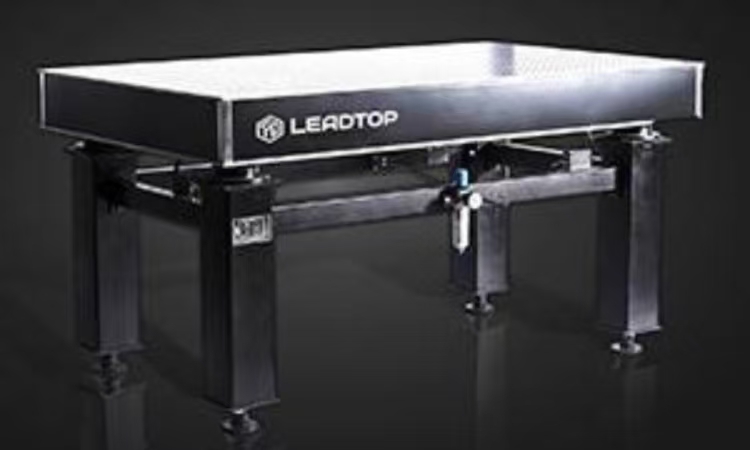
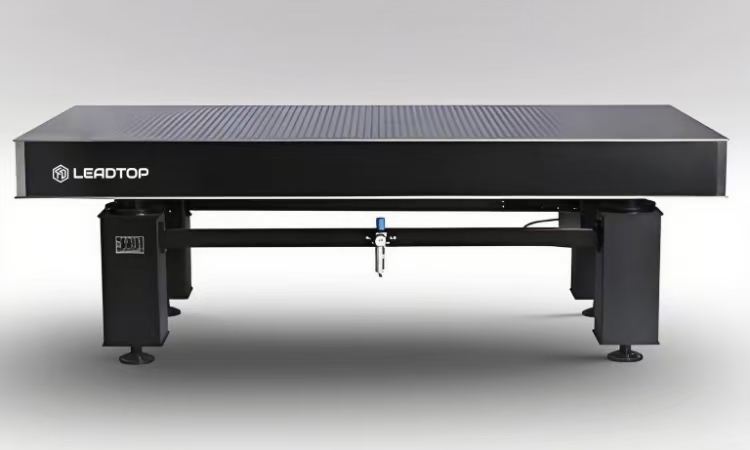
Both the LeadTop ZDT-P and ZDT-B Series support the silent compressor option.
4.1 Product Parameter Comparison
|
Parameter |
ZDT-P Series (air-spring type) |
ZDT-B Series (air-spring pendulum type) |
|
Natural Frequency (Vertical) |
1.0–2.0 Hz |
1.0–2.0 Hz |
|
Natural Frequency (Horizontal) |
— |
1.0–1.5 Hz |
|
Isolation Efficiency |
95% |
99% |
|
Leveling Method |
Pneumatic auto-leveling |
Pneumatic auto-leveling |
|
Height Adjustment |
±10 mm |
±10 mm |
|
Load Capacity Range |
Depends on model |
Depends on model |
|
Reference Price |
From ¥29,900 |
From ¥32,400 |
4.2 Technical Difference Analysis
(1) ZDT-P Series: semi-diaphragm air spring
Technical features:
Applicable scenarios:
Selection advice: the best value choice, suitable for most precision optical applications.
(2) ZDT-B Series: air spring + pendulum structure
Technical features:
Applicable scenarios:
Selection advice: the high-end choice, suitable for applications with extremely demanding isolation efficiency.
4.3 Selection Decision Table
|
Selection Factor |
Choose ZDT-P |
Choose ZDT-B |
|
Vibration Environment |
Normal vibration environment |
More complex vibration environment |
|
Isolation Efficiency Requirement |
95% is sufficient |
Requires top-tier 99% efficiency |
|
Horizontal Vibration Sensitivity |
Not sensitive |
Sensitive (ZDT-B recommended) |
|
Budget |
≈¥30,000 |
≈¥35,000 |
|
Equipment Type |
Routine optical equipment |
High-precision microscopy imaging |
Key takeaway: With a limited budget and routine applications, choose the ZDT-P Series; for ultimate isolation efficiency or sensitivity to horizontal vibration, choose the ZDT-B Series.
5.1 Installation Requirements
|
Item |
Requirement |
Remarks |
|
Floor flatness |
<2 mm/m |
Ensures platform stability |
|
Floor firmness |
Load capacity meets requirements |
Prevents floor deformation |
|
Air supply connection |
Configure a silent compressor |
Ensures stable air pressure |
|
Power supply |
220V/50Hz |
Standard laboratory power supply |
5.2 Routine Maintenance
|
Maintenance Item |
Frequency |
Content |
|
Air pressure check |
Weekly |
Ensure air pressure stays within the specified range |
|
Air supply filtering |
Monthly |
Clean or replace the filter |
|
Tabletop cleaning |
Daily |
Remove dust and oil stains |
|
Leveling check |
Quarterly |
Confirm the auto-leveling function works properly |
5.3 Troubleshooting Common Problems
|
Problem |
Possible Cause |
Solution |
|
Unstable tabletop |
Insufficient air pressure |
Check the air supply and adjust the pressure |
|
Leveling failure |
Blocked air line |
Clean the air line and replace the filter |
|
Increased noise |
Compressor malfunction |
Repair or replace the compressor |
|
Degraded isolation performance |
Aging air bladder |
Contact the manufacturer to replace the air bladder |
|
Service Item |
Content |
|
Vibration environment diagnosis |
Free on-site measurement and diagnostic report |
|
Solution design |
Customized solution based on equipment model and site conditions |
|
Supporting Equipment Selection |
Recommendations for supporting equipment such as silent compressors and air lines |
|
Installation and commissioning |
Professional engineers install and commission on site |
|
After-sales maintenance |
Nationwide service network, fast response |
|
Technical training |
Operator training to ensure correct use |
Q1: Is the air compressor of an air-spring isolation platform noisy?
LeadTop air-spring isolation platforms are paired with silent air compressors; models with noise <55 dB are recommended to meet laboratory environment requirements. Both the ZDT-P and ZDT-B Series support the silent compressor option.
Q2: Does an air-spring isolation platform require continuous power?
The air-spring isolation platform itself does not require power (passive isolation principle), but the supporting air compressor does. A regulated power supply is recommended to ensure stable air pressure.
Q3: Can an air-spring isolation platform be used in a teaching laboratory?
Yes, but the vibration environment should be assessed. If a teaching laboratory has frequent foot traffic and high vibration, air-spring isolation is recommended over damping isolation for better low-frequency isolation.
Q4: Which is more suitable for a confocal microscope, ZDT-P or ZDT-B?
Both are suitable. If your budget is limited, the ZDT-P is sufficient; for ultimate image stability, the ZDT-B is recommended (99% isolation efficiency and a lower horizontal natural frequency).
Q5: How do I determine whether my laboratory needs air-spring or active isolation?
We recommend contacting LeadTop for a free vibration environment diagnosis. If measurements show that vibration in the 0.5–5 Hz band exceeds the limit and the equipment is sensitive to ultra-low frequencies, active isolation is recommended; otherwise, air-spring isolation offers better value.
With their low natural frequency (1–3 Hz) and high isolation efficiency (90–99%), air-spring isolation platforms have become the mainstream choice for precision optical experiments.
LeadTop offers two air-spring isolation products:
Selection advice:
Contact Us
|
Channel |
Details |
|
Website |
https://www.opticaltable.cn |
|
Phone |
0791-88224425 / 18870003091 / 17607098516 |
|
|
sales@opticaltable.cn |
|
Address |
Room 1010, Mingzhu Plaza Business Office Building, No. 49 Jiefang West Road, Qingyunpu District, Nanchang, Jiangxi, China |
Written by Nanchang LeadTop Technology Co., Ltd., this article aims to provide professional air-spring isolation selection guidance for precision optics users.


