In the fields of precision instruments and high-end manufacturing, vibration control is a critical link for ensuring equipment accuracy and stability. Vibration isolators, as the core components of vibration control, come in many types with different principles, making many first-time users feel at a loss. From the simplest rubber isolators to high-tech active isolators, each vibration isolator type has its unique advantages and applicable scenarios. This article provides a comprehensive overview of mainstream vibration isolator types and helps you quickly understand their characteristics through comparative analysis.
Passive vibration isolators are the most fundamental and mature category among all vibration isolator types. They do not require external power or air sources, relying entirely on the physical properties of materials to achieve vibration isolation. Based on the materials used, passive isolators can be mainly divided into rubber isolators and spring isolators.
Rubber vibration isolators, with advantages such as simple structure, easy installation, and maintenance-free operation, have become one of the most widely used vibration isolator types. Taking the POT-P series solid rubber isolator as an example, it uses a composite rubber structure with a vertical natural frequency of 6.5–12 Hz, horizontal natural frequency of 3–8 Hz, damping ratio of 0.05–0.2, load coverage of 180–800 kg per unit, and recovery time under 5 seconds. These products are particularly suitable for microscopes, medical and biological equipment, and other scenarios with moderate vibration requirements.
The POT-G series hollow conical rubber isolator introduces structural optimization and innovation. Through conical rubber design, its natural frequency is further reduced to 4–8 Hz while maintaining high damping and short recovery cycles, effectively reducing resonance risk. With load coverage of 50–700 kg, it is suitable for optical manufacturing and precision measurement fields with higher vibration requirements.
Pneumatic vibration isolators are the "high-end players" among passive isolators. They use the elasticity of compressed air to form an "air cushion" between equipment and the ground, physically isolating vibration sources from equipment. Pneumatic isolators can achieve natural frequencies as low as 1–2 Hz, with isolation efficiency far exceeding that of rubber isolators.
The ZDT-B series pendulum-type pneumatic isolator is a typical representative of this vibration isolator type. It uses an ultra-thin composite air bag combined with a pendulum principle structure, with an external adjustable damper that effectively reduces resonance risk while providing automatic leveling and quiet operation. Performance specifications include a horizontal natural frequency of 1.0–1.5 Hz, vertical natural frequency of 1.0–2.0 Hz, and at 5 Hz frequency, vertical isolation efficiency of 86–92% and horizontal isolation efficiency of 88–94%. It is suitable for laser interferometry, high-precision microscopes, and other equipment with extremely high vibration requirements.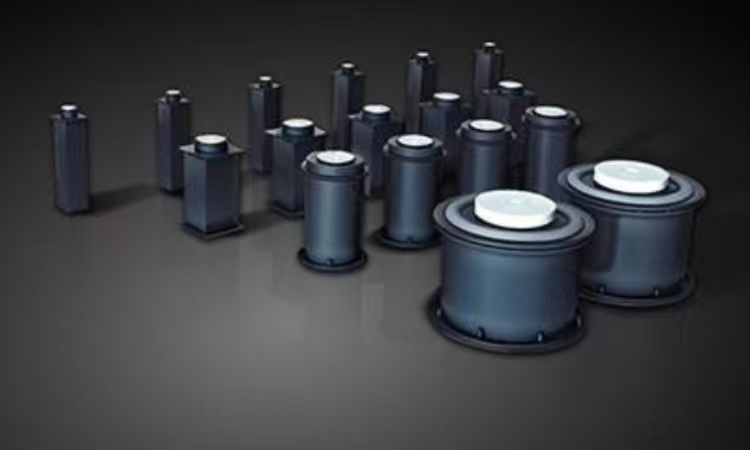
When selecting pneumatic isolators, users need to additionally consider air source system configuration. We recommend finding professional suppliers like LeadTop, a provider of vibration isolation optical platforms and accessories, for complete solutions from isolators to air source systems.
Active vibration isolators are the most technologically advanced category among all vibration isolator types. They use sensors to monitor vibrations in real time, control systems to rapidly calculate compensation strategies, and actuators to generate opposing forces that cancel out vibrations, forming a complete active control closed loop. The biggest breakthrough of active isolators is their ability to effectively handle low-frequency vibrations (1–10 Hz), a technical bottleneck that traditional passive isolators struggle to overcome.
Mainstream active isolators typically feature six-degree-of-freedom active compensation, isolation bandwidth covering 1–200 Hz, and response times ≤20 ms. Some high-end products also support digital communication protocols such as RS232 and EtherCAT.
In summary, rubber isolators excel in cost-effectiveness and are suitable for mid-to-high frequency isolation scenarios; pneumatic isolators excel in ultra-low frequency isolation performance and are suitable for high-precision equipment; active isolators win in intelligent control and low-frequency compensation capability, suitable for cutting-edge applications with extremely high vibration control requirements. In actual selection, users should choose the most matching vibration isolator type based on equipment vibration frequency characteristics, precision requirements, load capacity, and budget. For professional guidance, contact a professional vibration isolation optical platform and accessories supplier like LeadTop for support.


