The optical board—also called an optical breadboard or optical plate—as the fundamental mounting platform for optical components and precision instruments, has seen its application landscape expand dramatically from traditional optical laboratories into high-end technology sectors including medical diagnostics, semiconductor manufacturing, and aerospace. What a quality optical board provides is not merely a flat surface—it is a comprehensive mechanical solution that integrates planar reference, structural rigidity, and vibration isolation.
Using the MOT-F series honeycomb core optical platform breadboard as a concrete example, this article delves into the technical requirements and engineering practices of optical boards across various typical application scenarios, helping users from different fields more accurately understand the value proposition of optical boards in their respective applications.
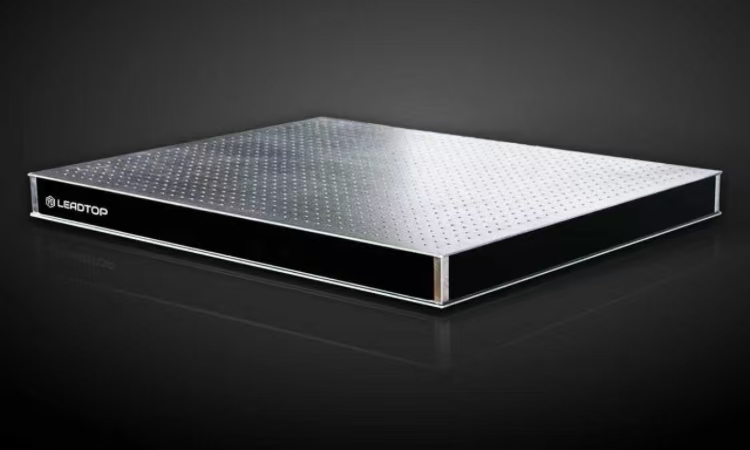
In basic optics laboratories at universities and research institutes, the optical board is the starting point for virtually all experimental optical path construction. From laser interferometry to spatial filtering and imaging, from Fourier optics to adaptive optics—all optical components—lasers, mirrors, beam splitters, lenses, and detectors—require sub-millimeter spatial positioning on a unified and stable reference plane. If the flatness of the optical board itself is inadequate, the minute height differences at each optical component mount in the optical path will be progressively amplified into a systematic drift in beam position after multiple reflections.
The MOT-F series optical board, with flatness of 0.05–0.1 mm/m², provides a reliable reference coordinate system for standard research optical paths. Furthermore, its high-permeability stainless steel (430) faceplate allows experimenters to use magnetic bases to rapidly and flexibly arrange and adjust optical paths on the optical board—for fundamental research that requires frequent changes to experimental configurations, this improvement in setup efficiency is substantial.
The lightweight advantage of honeycomb structures is also evident in research scenarios: when an experiment requires moving an entire optical setup from one optical board to another location, the reduced weight makes multi-person collaborative transport safer and more convenient.
In the field of interferometry—including Twyman-Green interferometers, Mach-Zehnder interferometers, and phase-shifting interferometers—the performance of the optical board directly defines the physical upper limit of measurement accuracy. Consider a Fizeau-type interferometer commonly used for mirror surface figure testing: both the reference flat and the test optic are mounted on the optical board, with an optical path difference between them on the order of tens of centimeters. If the optical board undergoes thermal expansion or bending deformation due to temperature changes, the relative orientation between the two mirrors will shift, and the mirror figure error measured by the interferometer will be contaminated by the deformation error of the optical board itself—meaning that even the best interferometer cannot deliver its nominal accuracy.
The MOT-F series optical board controls deformation below 2 µm/m², a magnitude that in interferometry means: within a one-square-meter area of the optical board, the maximum optical path error introduced by deformation of the board itself does not exceed two wavelengths (using a 632 nm He-Ne laser), fully satisfying the requirements of most high-precision interferometric measurements. Another advantage of honeycomb structures is thermal stability—the low thermal mass and fast thermal response of the trapezoidal thin steel plate honeycomb core plate keep the temperature difference between the faceplate and the core layer within a very small range, effectively reducing the risk of optical board warping driven by thermal gradients.
Holographic imaging is an imaging technique that is extremely sensitive to environmental vibration. During the recording process, the object beam and reference beam form micron-spaced interference fringes on the photosensitive material. If the optical board experiences micro-vibrations exceeding one-quarter of the laser wavelength during exposure, the contrast of the interference pattern will drop sharply, resulting in complete failure of the holographic recording.
The core value of honeycomb structure optical boards in this application lies in their outstanding damping characteristics: the numerous bonding interfaces within the trapezoidal thin steel plate honeycomb core plate form a complex energy dissipation network. When external vibration enters the optical board, the vibration energy is rapidly converted into trace amounts of heat and dissipated at the adhesive layers between adjacent honeycomb cell walls, preventing sustained low-frequency resonance within the body of the board.
Laser processing applications, such as femtosecond laser micro/nano fabrication, impose equally stringent stability requirements on the optical board—the positioning accuracy of the laser focus on the sample surface is typically in the micrometer range. If the optical board undergoes micrometer-scale elastic deformation due to building vibration during continuous processing, the entire machining pattern will exhibit visually discernible misalignment. The MOT-F series optical board's honeycomb structure offers a natural damping advantage against such high-frequency, low-amplitude vibrations, and its isolation cup design further eliminates acoustic coupling of noise into the internal cavity of the optical board through the mounting holes.
In the field of medical diagnostics, precision optical medical devices such as optical coherence tomography, flow cytometry, and laser confocal endoscopic imaging rely on optical boards as the unified mounting base for internal optical paths, continuously influencing the clinical credibility of diagnostic data throughout the equipment lifecycle.
Taking ophthalmic OCT as an example: the reference arm and sample arm optical paths within the device must maintain strict common-path alignment during prolonged continuous operation. Any optical path deviation caused by optical board deformation will directly translate into artifacts in retinal tomographic images—and such artifacts are unacceptable for clinical diagnoses such as retinal nerve fiber layer thickness measurement in glaucoma.
The rust-resistant, easy-to-clean characteristics of the MOT-F series optical board's stainless steel faceplate are particularly critical in medical equipment—the cleanliness requirements of laboratories and hospitals demand that the optical board surface must not produce rust spots or particle shedding.
The high-permeability stainless steel (430) faceplate remains deformation-free and rust-free over long-term use, perfectly meeting the dual requirements of material cleanliness and long-term stability in medical devices. As a supplier of vibration isolation optical platforms and accessories, LeadTop, through its engineering expertise in honeycomb structure optical boards, provides a robust, clean, and reliably stable internal optical path mounting platform for the development and production of medical optical instruments.
In the fields of aerospace optical calibration and ground testing of airborne optical payloads, optical boards face more demanding conditions than conventional laboratories—wide temperature cycling (-20°C to +50°C), high humidity, and mechanical shock and vibration during transportation—all of which impose extreme challenges on the long-term geometric stability of the optical board.
Honeycomb structure optical boards demonstrate the superiority of their structural design under these extreme conditions: the sandwich structure of faceplates and core gives the entire board a thermally symmetric response—the upper and lower faceplates employ the same material and similar thicknesses. When ambient temperature changes, the thermal expansion of the upper and lower faceplates is essentially identical, preventing the board from undergoing large-curvature bending due to mismatched thermal expansion between the top and bottom.
The energy absorption characteristics of the trapezoidal thin steel plate honeycomb core plate under vibration and shock provide the optical board with inherent cushioning capability during transportation. The MOT-F series optical board controls deformation below 2 µm/m², an accuracy grade that, in ground calibration experiments for aerospace optical payloads, ensures that the deviation in the optical path geometry between the calibration source and the payload under test remains below the system error tolerance despite environmental disturbances.
The high-permeability stainless steel faceplate and equally spaced precision threaded hole array employed by LeadTop in the MOT-F series optical board also provide convenient modular optical path construction capability in aerospace applications.
From optical path construction in fundamental scientific research to nanometer-scale surface figure analysis in interferometry, from sub-wavelength stability in holographic imaging to long-cycle reliability in medical diagnostic instruments, and onward to performance verification under extreme conditions in aerospace—the optical board, in its seemingly modest form as a flat surface, plays an irreplaceable foundational role in precision optical instruments and experimental systems.
A good optical board often defines the lower limit of performance for an entire optical system. We hope this technical analysis of optical boards across multiple application scenarios helps you more accurately evaluate and select the optical board solution suited to your application needs, laying a solid and reliable technical foundation for your precision experiments and inspections.


