Pure natural rubber is the traditional raw material for equipment vibration damping rubber pads, with advantages of good elasticity and low cost. However, under actual industrial vibration isolation conditions, pure natural rubber has three significant limitations: excessive creep, poor thermal conductivity, and insufficient weather resistance. Under sustained compression, rubber molecular chains slowly slip and rearrange, causing pad thickness reduction, hardness increase, and isolation performance degradation. This is the fundamental reason many factories' equipment vibration damping rubber pads need replacement after just three to five years.
To overcome these limitations, the industry's technical approach is to add reinforcing components to the base rubber, forming composite rubber formulations. This formulation upgrade is the critical step that elevates equipment vibration damping rubber pads from general-purpose products to industrial-grade products.
Polyester fiber is the first key reinforcing component in composite rubber formulations. Its mechanism of action: polyester fiber has high strength and low elongation characteristics. When uniformly dispersed in the rubber matrix, it acts like a three-dimensional network constraining the thermal movement of rubber molecular chains. When rubber is compressed, the molecular chains can no longer slip freely but are held in place by the fiber network, fundamentally suppressing creep occurrence.
The POT-X series equipment vibration damping rubber pads employ this composite rubber formulation, with a measured annual creep rate of just 21.5%, ten-year extrapolated value of approximately 35.6%, and service life exceeding 12 years. Compared to ordinary pure natural rubber, the creep rate is reduced several-fold, meaning that throughout the equipment's lifecycle, isolation performance degradation is controlled and predictable.
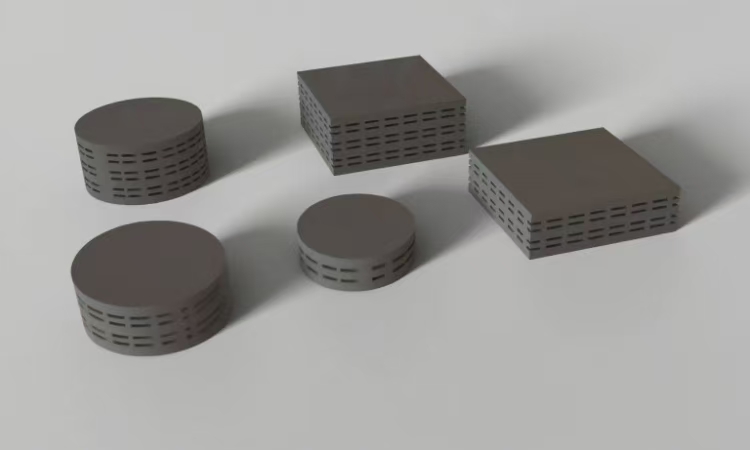
The second key reinforcing component in composite rubber formulations is graphite. Graphite's layered structure gives it excellent lubricity and thermal conductivity. When equipment vibration damping rubber pads are compressed, interlayer sliding of graphite reduces internal frictional heat generation in the rubber, minimizing the risk of accelerated material aging and creep due to local temperature rise. Simultaneously, graphite's thermal conductivity helps dissipate heat generated within the rubber body more quickly, maintaining temperature uniformity.
The dual reinforcement mechanism of polyester fiber and graphite works synergistically, making composite rubber equipment vibration damping rubber pads far superior to pure natural rubber products in comprehensive performance: lower creep rate, better thermal conductivity, longer service life, and more stable performance.
The technical value of composite rubber formulations is ultimately reflected in the long-term stable operation of equipment. The POT-X series equipment vibration damping rubber pads employ a proprietary composite rubber formulation (with polyester fiber and graphite additives), with vertical natural frequency of 6.5 to 16 Hz, horizontal natural frequency of 2 to 8 Hz, damping ratio of 0.05 to 0.2, service life exceeding 12 years, strong stability, excellent isolation performance, and particularly outstanding horizontal isolation effectiveness.
As a supplier of vibration isolation optical platforms and accessories, LeadTop deeply applies composite rubber technology in equipment vibration damping rubber pad products, providing industrial users with reliable and data-transparent vibration isolation solutions. Choosing composite rubber formulation equipment vibration damping rubber pads is essentially securing reliable insurance for the long-term stable operation of equipment.


