In the vibration control landscape for precision instruments and industrial equipment, anti vibration rubber isolators have long held an irreplaceable position thanks to their structural simplicity, maintenance-free operation, and cost-effectiveness. Unlike pneumatic isolation systems that require compressed air supply, anti vibration rubber isolators use high-performance rubber elastomers as their core working element, absorbing and dissipating vibrational energy through the material's inherent damping characteristics.
This article systematically examines the working principles, performance features, and selection criteria of anti vibration rubber isolators, focusing on two mainstream designs: solid rubber and hollow cone rubber configurations.
An anti vibration rubber isolator is a passive vibration isolation device that uses a rubber elastomer as its primary working medium, typically consisting of three components: metal connecting fixtures, a rubber elastic element, and a limiting structure. Its operating principle follows the mass-spring-damper model: when external vibration reaches the base of the anti vibration rubber isolator, the rubber elastomer undergoes shear or compressive deformation, converting kinetic energy into thermal energy for dissipation and thereby reducing the vibration amplitude transmitted to the supported equipment.
Compared with pneumatic isolation systems, anti vibration rubber isolators offer three core advantages.
First, they require no external air supply or complex piping and are ready for use immediately after installation.
Second, the inherent damping properties of rubber materials deliver excellent isolation performance in the mid-to-high frequency range.
Third, their compact structure and economical pricing make them ideal for large-scale deployment. In applications such as microscopy, medical biology, and optical inspection, anti vibration rubber isolators represent one of the most cost-effective vibration control solutions available.
Solid rubber anti vibration isolators employ integrally molded rubber blocks as the elastic element, achieving multi-directional vibration isolation through combined compressive and shear deformation of the rubber.
The LeadTop POT-P series solid rubber isolator is a representative example, with its core design innovation residing in the composite rubber structure—rubber units of varying hardness and geometric profiles are layered in a specific stacking sequence, enabling the anti vibration rubber isolator to achieve balanced isolation performance in both vertical and horizontal directions. This series places particular emphasis on horizontal isolation performance, achieving excellent mid-to-high frequency horizontal vibration attenuation through optimized shear stiffness of the rubber profile.
Structurally, the POT-P series anti vibration rubber isolator features a height adjustment base, allowing installation personnel to perform precision leveling via a threaded mechanism, ensuring uniform load distribution when multiple anti vibration rubber isolators cooperatively support equipment. An optional caster design further enhances deployment flexibility.
The POT-P series anti vibration rubber isolator delivers a vertical natural frequency of 6.5–12 Hz, horizontal natural frequency of 3–8 Hz, damping ratio of 0.05–0.2, load capacity of 180–800 kg per unit, and recovery time under 5 seconds—metrics that demonstrate reliable engineering practicality in the mid-to-high frequency isolation domain.
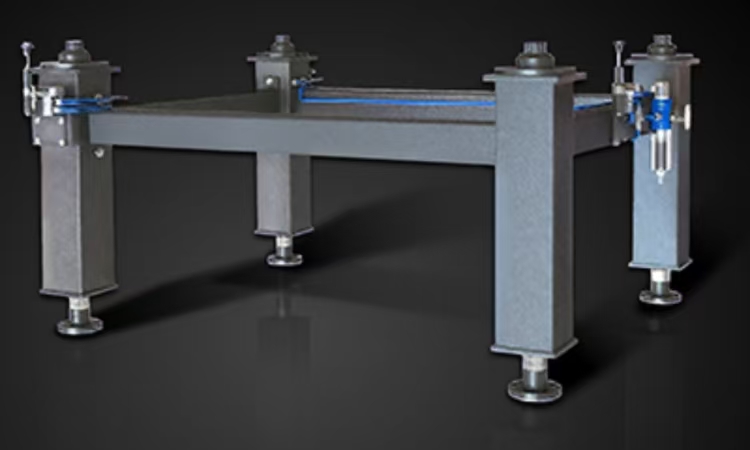
Hollow cone rubber anti vibration isolators represent a significant structural innovation in rubber isolation technology.
Unlike traditional solid rubber blocks that rely on bulk compression for isolation, the POT-G series anti vibration rubber isolator combines high-tech rubber compounds with a specially designed hollow cone geometry. The advantages of this geometry are threefold.
First, the hollow conical cross-section accommodates vertical loads while utilizing the wedge effect of the conical surface to expand the radial deformation range, significantly amplifying the damping response of the rubber material.
Second, the high damping characteristics of the anti vibration rubber isolator effectively suppress vibration amplification peaks near the resonance frequency, reducing resonance risk during startup, shutdown, or impact events.
Third, the hollow structure reduces the self-weight of the anti vibration rubber isolator while improving heat dissipation efficiency of the rubber body under cyclic loading, extending service life.
In terms of performance, the LeadTop POT-G series anti vibration rubber isolator achieves a natural frequency as low as 4–8 Hz, load capacity covering 50–700 kg, and—combined with a precision adjustment system and optional casters—is well-suited for precision applications such as microscopy and optical manufacturing that demand more stringent vibration control.

Anti vibration rubber isolators find extensive application across both scientific research and industrial domains.
In optical and biological microscope systems, anti vibration rubber isolators, with their economical installation cost and maintenance-free, ready-to-use nature, serve as standard configurations for most teaching and routine research laboratories.
In medical in-vitro diagnostic equipment, pathology slide scanners, and biochemistry analyzers, anti vibration rubber isolators provide reliable support that meets the vibration tolerance standards stipulated by equipment manufacturers. Additionally, in small optical platforms, precision balances, and laser marking equipment, anti vibration rubber isolators demonstrate excellent engineering compatibility.
For selection, match the anti vibration rubber isolator type to the vibration-sensitive frequency band of the equipment: for equipment primarily concerned with vibrations above 10 Hz, the POT-P series solid rubber anti vibration rubber isolator is an economical and efficient choice; for precision equipment requiring coverage down to the 4–8 Hz range with higher demands on resonance suppression, the POT-G series hollow cone rubber anti vibration rubber isolator is the superior option. As a supplier of vibration isolation optical platforms and accessories, LeadTop offers a complete product matrix of anti vibration rubber isolators covering various precision grades and budget ranges.
The installation quality of anti vibration rubber isolators directly impacts their isolation effectiveness. Before installation, ensure the foundation surface meets flatness requirements. Using the height adjustment base, calibrate each support point individually so that the static horizontal deviation of the anti vibration rubber isolators is kept within ±0.5 mm.
Although rubber materials are highly durable, it remains advisable to perform a visual inspection of anti vibration rubber isolators every 12 months, checking for surface cracks, permanent deformation, or bond failure between rubber and metal components.
For anti vibration rubber isolators used with casters, ensure the caster brakes are fully released before moving. Once at the target position, lower the anti vibration rubber isolators back into load-bearing mode and perform secondary leveling. Correct installation coupled with periodic maintenance inspections ensures that anti vibration rubber isolators deliver stable vibration isolation performance throughout their entire service life.
Anti vibration rubber isolators, with rubber materials at their core and diverse structural designs ranging from solid blocks to hollow cones, provide simple, reliable, and economical engineering solutions for mid-to-high frequency vibration control.
From foundational teaching laboratories to high-precision optical manufacturing facilities, anti vibration rubber isolators continue to deliver effective vibration protection across a wide range of precision applications with their maintenance-free, plug-and-play convenience.
We hope this technical analysis and selection guidance on anti vibration rubber isolators assists readers in making more informed and accurate decisions.


