Laser interferometric measurement is among the most precise measurement technologies available today, widely applied in frontier fields including gravitational wave detection, length standard dissemination, and optical component surface shape testing.
The principle of laser interferometry utilizes optical path differences to generate interference fringes, analyzing fringe variations to extract measurement information. However, interference fringes are extremely sensitive to vibration — nanometer-scale optical path changes can cause significant fringe drift, rendering measurement results meaningless.
This is precisely why air-supported optical tables are essential for such demanding applications. In typical laboratory environments, vibrations caused by ground motion, air conditioning operation, and personnel movement usually fall within the 1–100 Hz frequency range with amplitudes reaching the micrometer level, posing a severe threat to interferometric experiments.
Air-supported optical tables, with their ultra-low natural frequency and high isolation efficiency, can reduce vibrations transmitted to the optical system by one to two orders of magnitude, serving as critical equipment for ensuring laser interferometry reliability.
In a laser interferometric optical path, any minute displacement of optical components changes the optical path length, consequently causing interference fringe drift. Air-supported optical tables decouple the optical platform from ground vibrations through air springs, placing the optical system in a nearly "floating" state.
Taking the LeadTop ZDT-P series as an example, its vertical and horizontal natural frequencies are 1.0–2.0 Hz, achieving 78%–95% attenuation of vibrations above 5 Hz. This means that when a 10 Hz, 1-micrometer amplitude vibration exists on the ground, the vibration amplitude transmitted to the tabletop is only 0.05–0.22 micrometers — a substantial improvement in interference fringe stability.
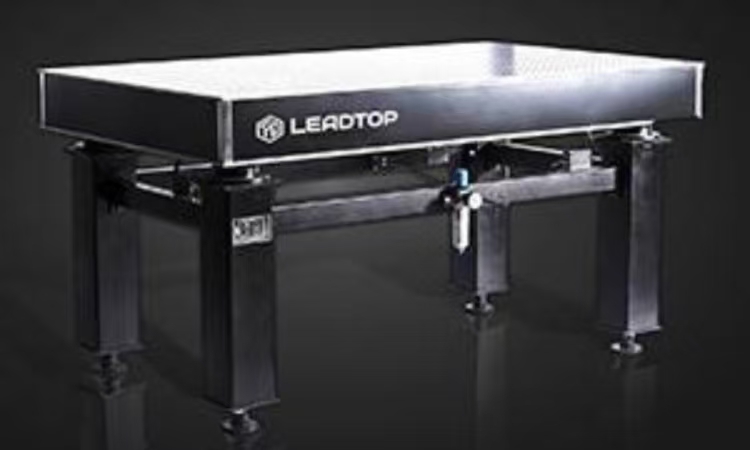
For even higher precision applications such as gravitational wave detection, the LeadTop ZDT-B series can be selected, whose pendulum rod structure reduces horizontal natural frequency to 1.0–1.5 Hz with isolation efficiency reaching 86%–99%, providing more powerful assurance for extremely precise interferometric measurements.
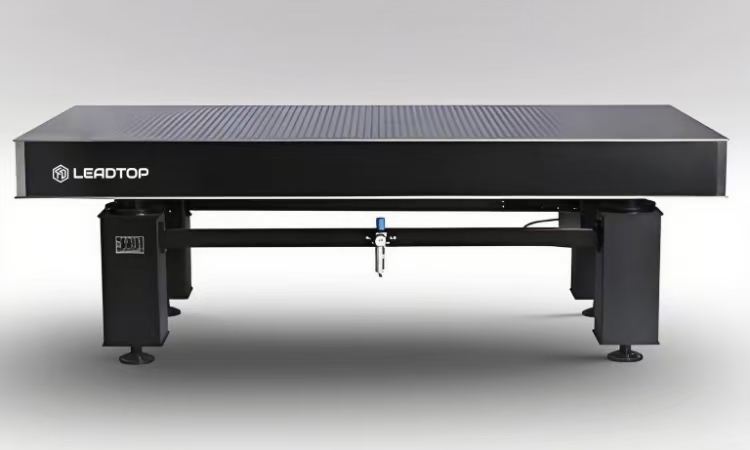
A high-performance air-supported optical table alone is not sufficient — rational optical path construction and table configuration are equally important.
First, tabletop flatness directly relates to the installation datum of optical components, with 0.05–0.1 mm/m² flatness being the basic requirement for building a stable interferometric optical path.
Second, matte surface finishing reduces stray light reflection from the tabletop that could interfere with the interference signal. In terms of load distribution, heavy equipment (such as lasers) should be placed as close to the table center as possible to minimize eccentric loading effects on isolation performance. The pneumatic auto-leveling function ensures that after each addition or removal of equipment, the tabletop quickly returns to a level state, avoiding optical path shifts caused by tilting.
Additionally, the silent air compressor (<50 dB) eliminates the need for additional soundproofing measures in the laboratory, creating a quiet experimental environment.
The value of air-supported optical tables in laser interferometry extends well beyond research laboratories. In industrial manufacturing, optical component surface shape inspection, large workpiece interferometric measurement, and fiber optic gyroscope assembly calibration all rely on stable interferometric measurement environments. As precision manufacturing imposes increasingly stringent tolerance requirements, the demand for air-supported optical tables in industrial settings continues to grow.
Choosing a professional supplier like LeadTop not only provides reliable performance isolation platforms but also delivers customized solutions for specific application scenarios — from tabletop dimensions and isolation leg configuration to compressor selection — comprehensively matching industrial environment usage requirements.
The success of laser interferometric experiments is inseparable from stable vibration isolation support. Air-supported optical tables, with their outstanding low-frequency isolation performance, intelligent auto-leveling, and precise tabletop machining, provide reliable vibration isolation assurance for interferometric measurements.
As the technology continues to evolve, air-supported optical tables are becoming even more effective at addressing complex vibration challenges across diverse fields. Whether you are engaged in fundamental research or industrial inspection, a properly selected air-supported optical table will be an important asset for improving measurement precision and experimental efficiency.


